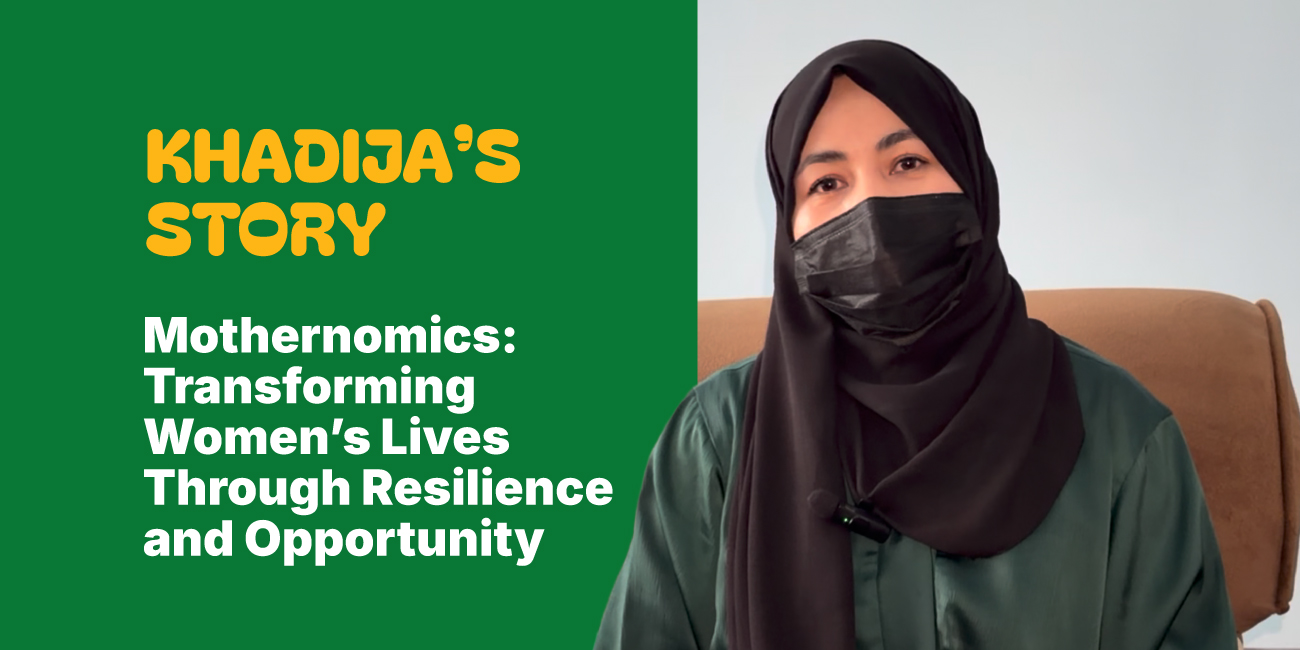
Khadija is a young Afghan woman from Ghazni Province, she grew up in an environment where girls were expected to limit their dreams, leave school early, and accept domestic work as their only path. From a young age, she faced the harsh reality that most girls around her did not imagine a future beyond household duties, and many slowly learned to silence their own ambitions due to cultural pressure, instability, and decades of conflict.
Despite these challenges, she refused to accept the limitations imposed on her. She fought against deeply rooted social norms, completed school, passed the competitive Kankor Exam, and earned admission to Kabul University. Her hard work led to a life‑changing scholarship in India, where she completed her Bachelor’s degree in Economics at Bangalore University, a breakthrough that proved possibility exists even for girls who come from places where hope is often discouraged.
Her return to Afghanistan in 2020 coincided with COVID‑19 and increasing political restrictions, especially those targeting women. Once again, she faced a future full of uncertainty. Yet she continued to persevere, pushing forward with her education and joining the Lady Fatemah Trust in 2022, where she regained confidence through training and leadership opportunities. Her work with widowed mothers, trauma‑affected students, and vulnerable families strengthened her commitment to empowerment and community resilience.
In 2023, she received a scholarship to pursue her MBA in Finance, balancing full‑time work with advanced academic studies. The concepts she learned, strategic management, design thinking, crisis management, and financial planning, were immediately applied to real program challenges in Afghanistan and Iraq, further enhancing her ability to impact the women she served.
Her capstone research analyzes the financial empowerment effects of the Mothernomics program across both contexts. She found that although Afghanistan and Iraq share cultural similarities, Afghan women face far deeper political, legal, economic, and technological restrictions, which directly impact program outcomes. Yet despite these limitations, the impact in Afghanistan is equal or even greater, because Mothernomics often becomes the mother’s only source of income, hope, and identity.
Why Her Story Matters
Her journey embodies exactly what Mothernomics stands for:
- Breaking generational barriers
- Defying restrictive systems
- Creating pathways where none existed before
- Transforming hardship into leadership
She is a product of educational opportunity, community support, and empowerment, and she is now using her skills to empower other women who come from the same circumstances she overcame. This full circle of empowerment is the greatest evidence of Mothernomics’ long‑term impact.
What is Mothernomics?
Mothernomics is a holistic women’s empowerment model that goes far beyond teaching a skill or providing an income. It is a lifeline for mothers who have lived through conflict, trauma, widowhood, poverty, and years of being told that their dreams do not matter.
At its core, Mothernomics combines economic opportunity, vocational training, mental health care, and community belonging into one integrated, trauma‑informed system. Mothers don’t just learn how to stitch garments—they rebuild confidence, stability, dignity, and hope.
So What Does Khadija’s Report Tell Us?
Khadija’s analysis provides strong, data-backed evidence that Mothernomics creates measurable financial, personal, and social transformation for women in Afghanistan and Iraq. Her findings, based on 60 participants (30 Afghanistan, 30 Iraq), show consistent, high-impact results across the board
1. Financial Empowerment: Women Are Earning, Controlling Income, and Supporting Their Families
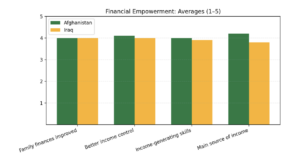
Across the four financial indicators measured on a 5‑point Likert scale, Afghanistan and Iraq both show high averages, with Afghanistan slightly higher in most areas.
Financial Empowerment Scores
- Family finances improved: Afghanistan 4.0, Iraq 4.0
- Better control over income: Afghanistan 4.1, Iraq 4.0
- Improved income‑generating skills: Afghanistan 4.0, Iraq 3.9
- Becoming the main income source: Afghanistan 4.2, Iraq 3.8
What this means:
Women are not only earning, they are becoming primary breadwinners, often for the first time, especially in Kabul.
2. Personal Empowerment: Strong Improvements in Independence, Confidence, and Hope
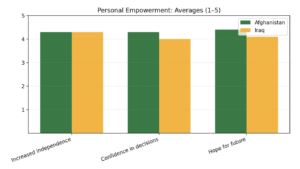
Mothernomics dramatically strengthens women’s sense of self, emotional resilience, and future outlook.
Personal Empowerment Scores
- Independence: Afghanistan 4.3, Iraq 4.3
- Confidence in decision‑making: Afghanistan 4.3, Iraq 4.0
- Hope for the future: Afghanistan 4.4, Iraq 4.1
What this means:
Across both countries, women feel more capable, more hopeful, and more in control of their lives.
3. Limitations: Afghanistan Faces Severe Structural Barriers
Khadija’s report reveals a stark contrast in the environments where Mothernomics operates.
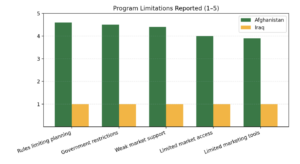
Limitations Reported – Afghanistan (Averages 1–5):
- Rules limiting planning: 4.6
- Government restrictions: 4.5
- Weak market support: 4.4
- Limited market access: 4.0
- Limited marketing tools: 3.9
Limitations Reported — Iraq:
All indicators scored 1.0 (Strongly Disagree) — meaning women face minimal barriers.
What this means:
In Afghanistan, the environment is extremely restrictive. Despite that, women still show equal or stronger improvements, proving the program’s deep necessity.
4. Production Impact: Thousands of Garments Benefitting Vulnerable Families
Khadija highlights significant output numbers:
- 14,000+ garments produced in Afghanistan and distributed to orphans, widows, and vulnerable families.
- 25,000+ garments annually produced in Iraq.
- 250+ Iraqi women trained since 2020.
What this means:
Mothernomics simultaneously lifts mothers and meets community needs at scale.
5. Mothernomics simultaneously lifts mothers and meets community needs at scale
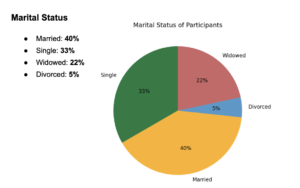
The data shows most women start with low education levels and high vulnerability.
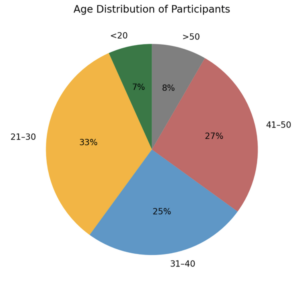
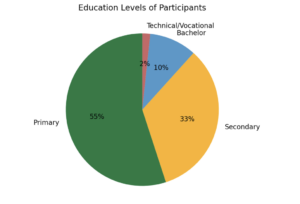
Education Levels (Across 60 participants)
- Primary education: 55%
- Secondary: 33%
- Bachelor’s degree: 10%
- Technical/Vocational: 1.67%
What this means:
Mothernomics is reaching the exact demographic most affected by economic instability, trauma, widowhood, and lack of opportunity.
6. Qualitative Evidence Confirms the Data: Emotional, Skill-Based, and Social Transformation
Khadija’s interviews revealed four consistent themes:
- Economic empowerment — paying bills, supporting children, stability
- Skill development — tailoring, literacy, technical ability
- Emotional growth — confidence, healing, reduced stress
- Social belonging — teamwork, identity, purpose